
Table of Contents
As an Amazon Associate, we earn from qualifying purchases. This means we may receive a small commission at no extra cost to you when you buy through links on this page.
Introduction: Why the Right Headphones Matter for Music Production
For any music producer, choosing the right headphones is arguably as important as the Digital Audio Workstation (DAW) itself. Accurate sound reproduction is paramount – you need to *hear* what you’re creating without colouration. This is critical for making informed mixing and mastering decisions. Comfort is also a huge factor; long production sessions demand headphones you can wear for hours without fatigue. Finally, isolation – or lack thereof, depending on your needs – plays a role in preventing sound bleed during recording and providing a focused listening environment.
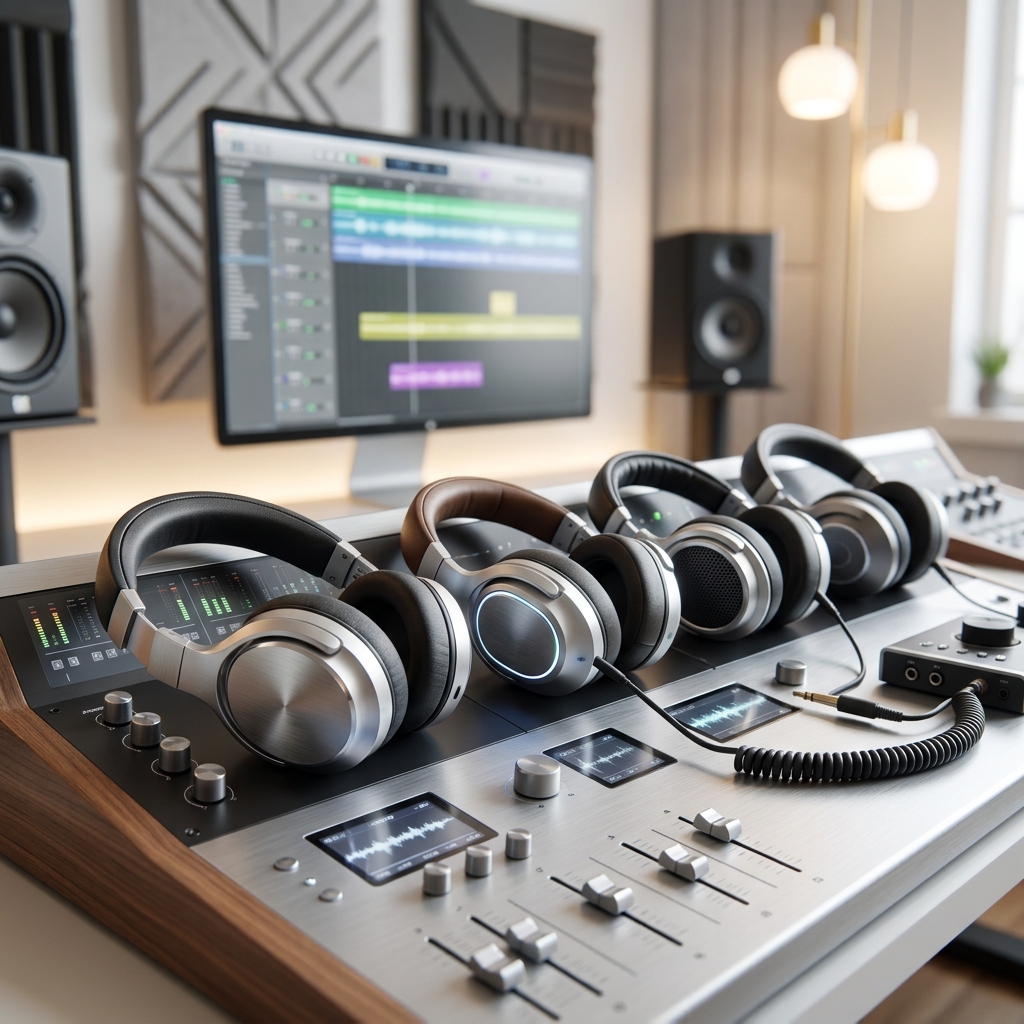
There are three main types of headphones relevant to music production: open-back, offering a wide soundstage but minimal isolation; closed-back, providing good isolation but potentially a narrower soundstage; and in-ear monitors (IEMs), offering portability and isolation, ideal for on-the-go work and critical listening. Each has its strengths and weaknesses, depending on the stage of production you’re at.
Understanding Headphone Specs for Music Production
Navigating headphone specifications can be daunting. Here’s a breakdown of the key specs you should consider:
- Frequency Response: Measured in Hertz (Hz), this indicates the range of frequencies the headphones can reproduce. For music production, look for a wide and *flat* frequency response – ideally from 20Hz to 20kHz with minimal peaks or dips.
- Impedance: Measured in Ohms (Ω), impedance affects how much power the headphones require. Lower impedance headphones (e.g., 32Ω) work well with mobile devices, while higher impedance headphones (e.g., 250Ω+) often require a dedicated headphone amplifier for optimal performance.
- Total Harmonic Distortion (THD): Expressed as a percentage, THD measures the amount of distortion added to the sound. Lower THD values are better, indicating cleaner and more accurate audio.
- Driver Size: Generally, larger drivers (measured in mm) can move more air, potentially resulting in a fuller and more impactful sound. However, driver size isn’t everything; quality of materials and design are equally important.
Best Over-Ear Headphones for Music Production (2026)
Beyerdynamic DT 770 Pro (80 Ohm)
Price: £149.99
The DT 770 Pro remains a studio staple. Known for its detailed sound and comfortable velour ear pads, it’s a great all-rounder. The 80 Ohm version is versatile enough to be driven by most interfaces.
- Pros: Excellent detail, comfortable, durable, relatively affordable.
- Cons: Can be a bit bass-heavy for critical mixing, closed-back design limits soundstage.
Audio-Technica ATH-M50x
Price: £169.00
Another industry favourite, the ATH-M50x offers a clear and accurate sound signature in a robust build. Its collapsible design makes it ideal for portability.
- Pros: Accurate sound, portability, durable construction.
- Cons: Soundstage somewhat limited, can become uncomfortable after extended use.
Sennheiser HD 660S2
Price: £399.99
The successor to the legendary HD 650, the HD 660S2 delivers a refined and natural sound with exceptional clarity. It’s a fantastic choice for critical listening and mastering, and requires a good headphone amplifier to shine.
- Pros: Exceptional clarity, natural sound, comfortable.
- Cons: Requires a headphone amp, open-back design not ideal for tracking.
Sony MDR-7506
Price: £99.00
An incredibly popular and affordable option, the MDR-7506 is known for its robust build and relatively neutral sound. A solid choice for beginners or as a backup pair.
- Pros: Affordable, durable, relatively neutral sound.
- Cons: Comfort can be an issue for long sessions, limited soundstage.
Shure Aonic 5
Price: £449.00
The Aonic 5 focuses on delivering a highly detailed and accurate sound. They feature a comfortable design and come with a selection of earpads to fine-tune the sound signature to your preference.
- Pros: Detailed sound, comfortable, customisable sound signature.
- Cons: Expensive, requires a good source to truly shine.
Best In-Ear Monitors (IEMs) for Music Production (2026)
1More Triple Driver In-Ear
Price: £129.99
Offering a surprisingly detailed and balanced sound for the price, the 1More Triple Driver IEMs are excellent for critical listening on the go. They provide good isolation and a comfortable fit (with included ear tips).
- Pros: Excellent value, detailed sound, good isolation, portable.
- Cons: Fit can be tricky for some ears.
Open-Back vs. Closed-Back Headphones: Which is Right for You?
Here’s a comparison:
| Feature | Open-Back | Closed-Back |
|---|---|---|
| Soundstage | Wide and natural | Narrower |
| Isolation | Minimal | Good |
| Sound Leakage | Significant | Minimal |
| Use Cases | Mixing, mastering, critical listening in a quiet environment | Tracking, recording vocals, monitoring in noisy environments |
Wired vs. Wireless Headphones for Music Production
While Bluetooth technology has improved, wired headphones remain the preferred choice for most music producers. Wireless headphones introduce latency, even with modern codecs like aptX Adaptive and LDAC, which can be detrimental when monitoring live instruments or performing critical edits. Audio quality can also be compromised by Bluetooth compression.
Wired:
- Pros: Zero latency, highest audio quality, reliable connection.
- Cons: Cable can be restrictive.
Wireless:
- Pros: Freedom of movement, convenience.
- Cons: Potential latency, audio quality compromise, battery life concerns.
Headphone Accessories for Music Production
Enhance your listening experience with these accessories:
- Headphone Amp: The RME Babyface Pro FS (£279.00) isn’t just an audio interface; it boasts a superb headphone output, perfect for driving high-impedance headphones.
- Replacement Ear Pads: Dekoni Audio Elite Sheepskin Ear Pads (£79.99) can significantly improve comfort and sound isolation.
- Headphone Stand: A dedicated stand protects your headphones and keeps them organised.
- Carrying Case: Essential for protecting your headphones when travelling.
Budget Options: Great Headphones Under £150 (2026)
You don’t need to spend a fortune to get good sound. The Beyerdynamic DT 770 Pro (80 Ohm) at £149.99 and Sony MDR-7506 at £99.00 offer excellent value for basic music production tasks.
Future Trends in Headphones for Music Production
The headphone landscape is constantly evolving. We’re seeing:
- Spatial Audio: Headphone technology is improving to create more immersive and realistic spatial audio experiences.
- Personalised EQ: Algorithms are becoming more sophisticated in tailoring the sound signature to an individual’s hearing profile.
- Advanced Noise Cancellation: Noise cancellation technology continues to improve, offering even greater isolation in noisy environments.
Conclusion: Choosing the Right Headphones for Your Workflow
Our Top Pick: For an all-round studio workhorse, the Sennheiser HD 660S2 (£399.99), paired with a quality headphone amplifier, offers exceptional clarity and a natural sound. However, if budget is a concern, the Beyerdynamic DT 770 Pro (£149.99) remains an excellent choice.
Ultimately, the best headphones for you depend on your specific needs, budget, and workflow. Consider the type of music you produce, the environment you work in, and your personal preferences when making your decision. Don’t be afraid to try out different models to find the perfect fit.
FAQ
Q: Are open-back headphones suitable for recording vocals?
A: Generally no. The lack of isolation in open-back headphones means sound will bleed into the microphone, resulting in unwanted noise in your recordings.
Q: What impedance headphones should I choose?
A: If you’re using a dedicated audio interface with a built-in headphone amplifier, higher impedance headphones (250Ω+) are a good choice. For mobile devices or interfaces with weaker headphone outputs, lower impedance headphones (32Ω or 80Ω) are more suitable.
Q: Do I *need* a headphone amplifier?
A: It depends on your headphones’ impedance and the power output of your audio interface. If your headphones sound quiet or lack detail, a headphone amplifier can make a significant difference.
Q: How important is a flat frequency response?
A: Extremely important for accurate mixing and mastering. A flat frequency response ensures you’re hearing the audio as it truly is, without any artificial emphasis or attenuation.